








When two pharmaceutical companies merge, the commercial logic is usually settled long before anyone opens the quality manual. Portfolios are assessed, sites are mapped, synergies are modelled. Then integration begins, and the quality organisation discovers it has inherited a problem that no spreadsheet of synergies anticipated: two complete, mature, fully compliant quality management systems that do not agree with each other.
Both met regulatory expectations. Both passed inspections. Neither is wrong. They simply describe how work gets done in different words, with different process models, different document structures and different ideas about who owns what.
The instinct at this point is to treat it as a document problem: pick a winner, migrate the other side’s SOPs, retire the duplicates. That instinct produces a larger QMS rather than a unified one, and it tends to surface eighteen months later as an inspection finding or as two sites that still work the way they always did.
QMS harmonization is the alternative, and it starts somewhere less obvious than the documents.
Key takeaways
- QMS harmonization after a merger is a process problem, not a document problem. Consolidating SOPs without a shared process model builds a bigger system on top of two legacy silos;
- A process-oriented QMS rests on four things: a process landscape, a governance model that names owners, a document hierarchy, and metadata connecting documents to processes;
- Ownership is the hardest element. Two organisations rarely assign the same process to the same function, and unresolved ownership is where harmonization stalls;
- AI can accelerate analysis and mapping of thousands of controlled documents, but interpretation, process design, governance decisions and approval stay with qualified people;
- Any AI used on GxP content is a computerised system in regulatory scope and needs a validation approach agreed before deployment, not after.
Why QMS integration after a merger is harder than it looks
A quality management system is the organised expression of how a company believes work should be done. Merge two companies and you merge two of those beliefs, both of which have been validated by years of successful operation.
The differences that matter are rarely about compliance:
- Process models: one organisation may treat change control as a single end-to-end process; the other may split it across three functions;
- Document structures: different hierarchies, different document types, different granularity for the same activity;
- Ownership practices: one side runs formal process ownership; the other assigns documents to departments;
- Terminology: the same word describes different activities, and different words describe the same one;
- Metadata and findability: what one system indexes cleanly, the other stores as an attachment.
None of these is a deficiency. All of them are obstacles to operating as one company, because every one of them means a person at Site A and a person at Site B cannot follow the same instruction and arrive at the same place.
This is also why the document-consolidation approach fails. Choosing System A over System B does not remove System B’s process model; it removes only its paperwork, while the people who worked that way continue to do so. The merged organisation ends up with one document set and two ways of working, which is a worse position than where it started, because the gap is now invisible.
The alternative is to build the structure first.
What is a process-oriented QMS?
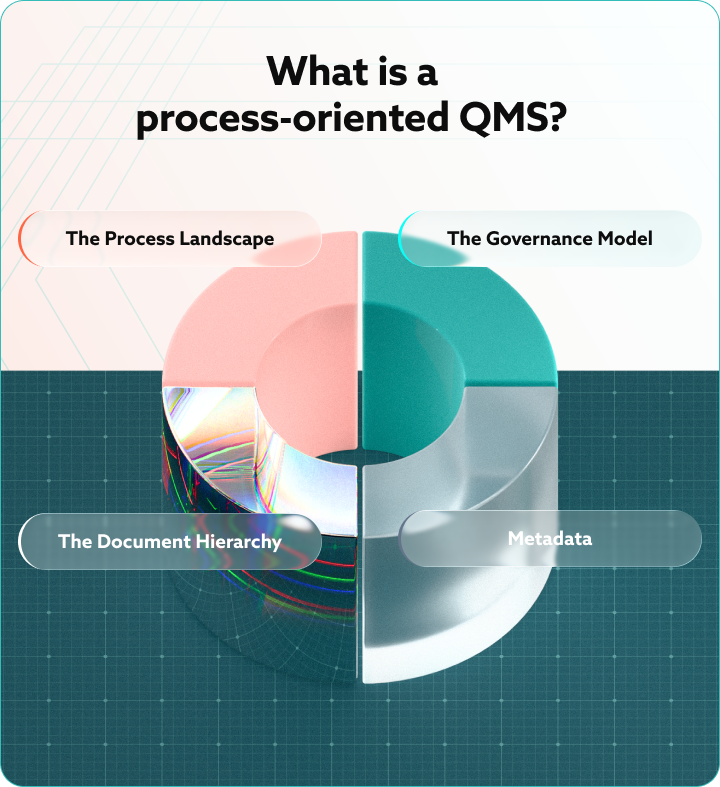
A process-oriented QMS organises the quality system around the processes the organisation actually runs, rather than around the documents it has accumulated. Documents remain essential, but they hang off the process model instead of defining it. A controlled document exists because a process needs it, and its owner is the owner of that process.
This is the structure regulators already assume. ICH Q10 describes a pharmaceutical quality system spanning the full product lifecycle, built on management responsibility, a state of control and continual improvement. A system organised by document type cannot easily demonstrate any of those things. A system organised by process can.
A process-oriented QMS backbone has four components:
- The process landscape: the shared view of how the merged organisation works, from high-level process groups down to the individual processes that produce quality outcomes;
- The governance model: who owns each process, who maintains it, who approves changes, and how that ownership is exercised;
- The document hierarchy: the logical structure for controlled content, from quality manual through policies and procedures to work instructions and records;
- Metadata: the attributes that connect a document to its process, its owner, its sites and its lifecycle state, and make it findable.
Each component is straightforward to describe and difficult to agree. Which is precisely why this is the work, and why it belongs at the start of an integration rather than at the end.
Where post-merger QMS harmonization actually stalls

In practice, integration programmes rarely fail on the process landscape. They fail on the governance model, for a reason that is organisational rather than technical.
Assigning a process owner after a merger means answering three uncomfortable questions at once:
- Which of the two existing owners keeps the process;
- Which function it belongs to, when the two organisations placed it differently;
- What happens to the way of working the other owner spent a decade refining.
Those are not quality questions. They are structural questions, and a quality team cannot resolve them alone. The practical consequence is that harmonization programmes which begin without executive sponsorship of the governance model will stall at exactly this point. It usually happens after the document analysis is complete, so the stall is expensive as well as frustrating.
The second failure point is scope. A merged organisation typically holds several thousand controlled documents. Reviewing them sequentially, by hand, takes longer than the integration timeline allows, and the pressure to hit the timeline is what produces the shortcut: adopt one system wholesale, migrate the other, declare completion. Which returns us to the original problem.
Thousands of documents, a fixed timeline and decisions that require human judgment. That is where the technology question finally becomes relevant.
Where AI in quality management helps, and where it does not

The volume problem is real, and it is the part of QMS harmonization that machines are legitimately good at.
What AI does well on a QMS integration:
- Clustering: grouping thousands of controlled documents into natural families, giving the team a structured view of a landscape nobody has seen whole;
- Mapping: proposing which documents attach to which processes in the target landscape, at a speed no manual review matches;
- Comparison: placing two SOPs that describe overlapping activities side by side and surfacing the differences, overlaps and contradictions;
- Gap detection: flagging processes with no supporting documentation, and documents supporting no identified process.
What AI does not do:
- Decide which process model the merged organisation should adopt;
- Determine who owns a process;
- Judge whether a harmonized procedure remains compliant with the relevant regulatory expectations;
- Approve a controlled document.
The distinction is not philosophical. It is the difference between acceleration and abdication. A clustering result is an input to a design decision; it is not the decision. Every output that touches controlled content still requires review, interpretation and approval by people qualified to give it, and the audit trail has to show that.
Validation: AI on GxP content is a computerised system
This is the part most commonly skipped. A tool that analyses, maps or drafts controlled documents is a computerised system used in a GMP-regulated activity, and both EU GMP Annex 11 and 21 CFR Part 11 apply on that basis.
Before an AI tool touches controlled content, agree:
- Its documented intended use: what it proposes, and what it is not permitted to decide;
- A risk assessment proportionate to that use;
- How its outputs are reviewed, by whom, and how that review is evidenced;
- Audit trail coverage for what the tool generated and what a human changed;
- Data handling, including whether controlled content leaves the validated environment.
Setting the validation approach at design time costs days. Retrofitting it to a tool already in use costs the programme its schedule, and occasionally its credibility with the inspector who asks how the harmonized SOP was produced.
A working sequence for QMS harmonization
The approach that holds runs two tracks in parallel rather than in series, because the structure and the content inform each other.
Top-down: design the backbone
Build the process landscape, the governance model, the document hierarchy and the metadata structure before migrating anything. Use recognised life sciences process frameworks as a starting point rather than negotiating a taxonomy from first principles. The argument is rarely worth the months it takes.
Bottom-up: harmonize the content
Work through the document families in priority order, comparing overlapping procedures, resolving differences and producing harmonized content against the agreed structure. Prioritise by inspection exposure and by how many people follow the procedure daily, not by folder order.
Sequence the decisions, not just the tasks
Ownership decisions gate content decisions. An SOP cannot be harmonized until someone owns the process it describes, because otherwise nobody can approve the result. Map the decision dependencies at the start and escalate the ones that need executive sign-off early, while the integration still has attention and budget.
Keep the quality control unit close to the work
The people who will operate the harmonized system should be shaping it throughout, not receiving it at go-live. A QMS the organisation did not help build is a QMS the organisation works around. The workarounds are what deviation handling eventually surfaces, one investigation at a time.
What this looks like with real data behind it
The closest BGO LifeScience Technologies reference point is the Drug Manufacturing Intelligence Solution built for a top-five pharmaceutical company in Switzerland: a web-based GMP platform for process and product monitoring and continued process verification, compliant with 21 CFR Part 11, with workflow review and approval and full audit trail.
It is relevant here for one reason. The engagement required defining more than 3,000 attributes that previously had no digital representation, connecting over 50 data sources, and standardising monitoring approaches across manufacturing locations worldwide so that roughly 1,000 users worked from the same definitions. Manual reporting fell from around 130 hours to 29, and the client reports annual savings in excess of CHF 6 million.
That is the same class of problem as QMS harmonization, expressed in data rather than documents: many sources, no common definitions, inconsistent approaches by location, and a requirement that the result be defensible to a regulator. The work that made it succeed was agreeing the definitions before building anything.
Conclusion
The temptation after a merger is to measure QMS integration by document count: how many procedures retired, how many migrated, how much of the legacy system switched off. Those numbers are easy to report and they describe almost nothing about whether the merged organisation now works as one company.
The useful measures are quieter. Whether a process has one owner. Whether two sites reading the same procedure do the same thing. Whether a person can find the current version of a document without knowing which legacy system it came from. Whether the inspection readiness of the combined organisation is better than the average of its parts, rather than worse.
Getting there takes a process landscape, a governance model with names against it, a document hierarchy, and metadata that connects the three. AI can compress the analysis dramatically. It cannot make the decisions, and a programme that expects it to will produce a harmonized-looking QMS that nobody owns.
If you are facing that integration, the first question is not which system wins. It is what your process landscape looks like when both organisations are described in one model, and who is going to own each part of it.
Frequently Asked Questions (FAQ)
What is a pharmaceutical quality management system?
A pharmaceutical quality management system (QMS) is the formal framework of processes, procedures, responsibilities and controlled documentation through which a company ensures its products consistently meet quality requirements and regulatory expectations. In a GMP environment it covers document control, change control, deviation and CAPA management, supplier quality, training, internal audit and management review. ICH Q10 provides the reference model, describing a pharmaceutical quality system that spans development, technology transfer, commercial manufacturing and product discontinuation, built on management responsibility, a state of control and continual improvement.
What is QMS harmonization?
QMS harmonization is the process of bringing two or more quality management systems into a single coherent system with a shared process model, one governance structure, a common document hierarchy and consistent ways of working. It is distinct from document consolidation, which migrates or retires documents without reconciling the underlying processes. Harmonization is most commonly triggered by a merger or acquisition, but also by site network consolidation, a move to a single eQMS platform, or a regulatory commitment following inspection findings across multiple sites.
How long does post-merger QMS integration take?
It depends far less on document volume than on how quickly ownership decisions get made. The analysis and mapping of several thousand controlled documents can be compressed into weeks with AI assistance and a clear target structure. Agreeing the process landscape and the governance model, meaning who owns which process in the combined organisation, is the constraint, because it requires executive decisions about structure rather than quality decisions about content. Programmes that secure those decisions early finish; programmes that defer them stall after the analysis phase with the expensive work already done.
Can AI be used on GxP documents?
Yes, with controls. AI is well suited to clustering, mapping, comparison and gap detection across large volumes of controlled documentation, and these are exactly the tasks that make manual QMS harmonization slow. What it must not do is make the decisions: process design, ownership, regulatory interpretation and document approval remain with qualified people. Because the tool acts on GMP-regulated content, it falls within the scope of EU GMP Annex 11 and 21 CFR Part 11, which requires documented intended use, a proportionate risk assessment, evidenced human review, and audit trail coverage of what the tool produced versus what a person changed.
What is a process-oriented QMS, and how does it differ from a document-based one?
A document-based QMS is organised around the documents it contains: the hierarchy is the filing structure, and ownership typically sits with departments. A process-oriented QMS is organised around the processes the business runs. Documents exist because a process requires them, and each one inherits the owner of its process. The practical difference shows at inspection and at change. In a process-oriented system you can demonstrate how a process is controlled end to end and identify every document affected by a change to it. In a document-based system, both of those require someone who knows where things are kept.
Sources
- ICH Q10 Pharmaceutical Quality System (EMA)
- EudraLex Volume 4, Annex 11: Computerised Systems (European Commission)
- 21 CFR Part 11: Electronic Records; Electronic Signatures (eCFR)
- Quality Systems Approach to Pharmaceutical Current Good Manufacturing Practice Regulations (FDA guidance, 2006)

Healthcare business analyst with expertise in marketing and business development, and holds an MPharm degree. He specialises in creating and executing communication strategies that make digital health solutions and pharmaceutical technologies clear, accessible, and resonation for their audiences.
link to the author’s linkedin profile